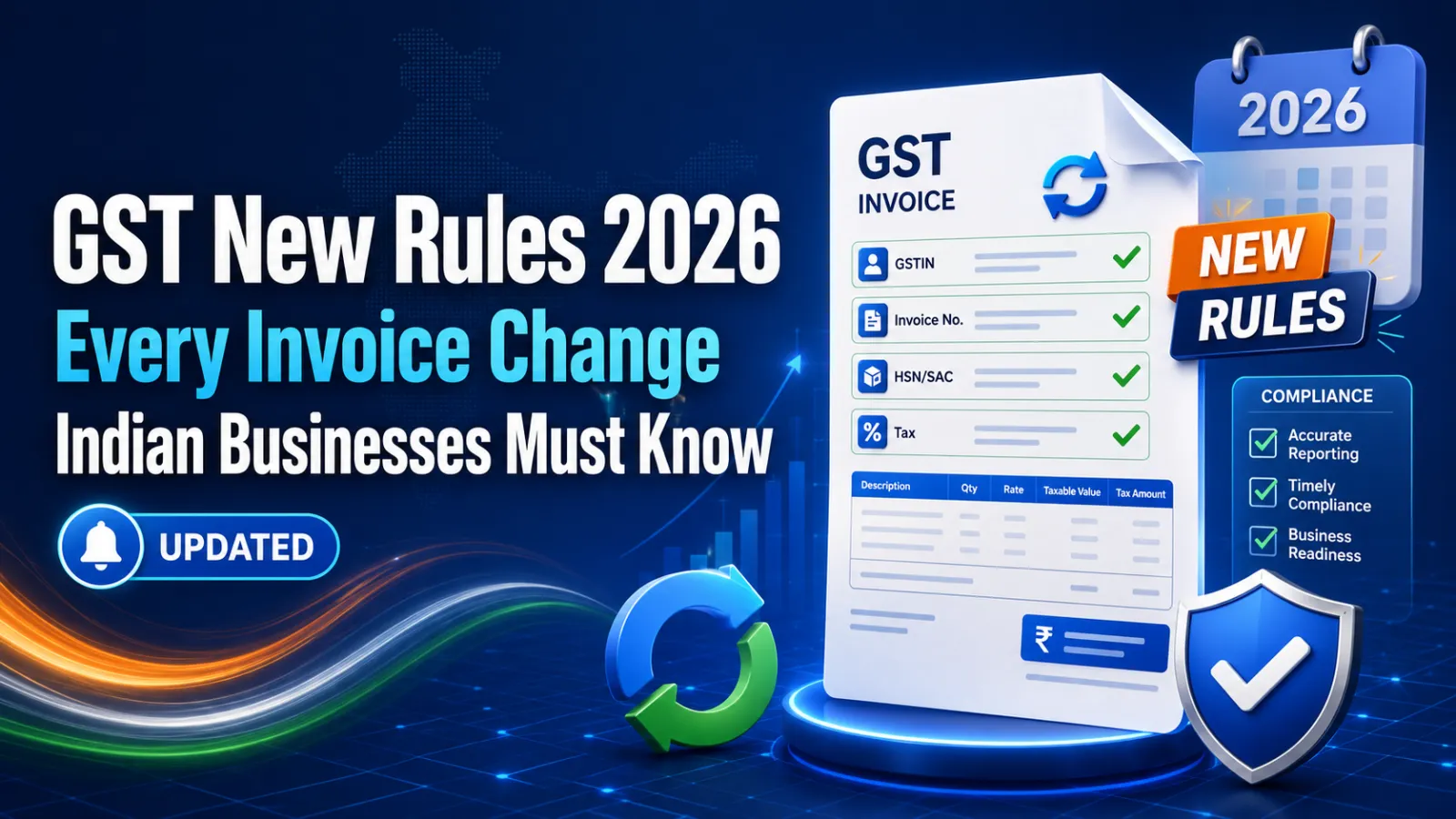
GST New Rules 2026: Every Invoice Change Indian Businesses Must Know (Updated April 2026) If you're an Indian business owner, freelancer, or accountant — 1 April 2026 quietly changed the rules of GST invoicing in ways most people are still unaware of. Fresh invoice series. New e-invoicing thresholds. A strict 30-day reporting window. Mandatory LUT filing for exporters. New tax slabs. And a list of compliance traps that, if missed, can block your GST return filing or invalidate your buyer's Input Tax Credit (ITC). This guide breaks down every GST change from April 2026 in plain English — what's new, what it means for you, and exactly what to do to stay compliant. No jargon. No fluff. Just clear actions.
TL;DR — GST 2026 Rule Changes (Quick Summary) ChangeWhat's NewWho's AffectedEffective DateFresh Invoice SeriesRestart numbering from INV-2026-001All GST-registered businesses1 April 2026E-invoicing ThresholdMandatory if AATO > ₹5 croreBusinesses crossing ₹5 Cr in any year since FY 2017-18Already active in 202630-Day Reporting WindowInvoices must be reported to IRP within 30 daysBusinesses with AATO > ₹10 crore1 April 2025 (strictly enforced)LUT Filing (FY 2026-27)Fresh Letter of Undertaking requiredAll exportersBefore first export invoice in April 2026₹1,000 Refund Threshold RemovedAll valid export refunds processedExporters1 April 2026GST 2.0 — New Tax SlabsSimplified two-slab structure (5% & 18%)All businessesLive0% GST on Health/Life InsurancePremiums fully exemptInsurance customersLiveECRS Negative Balance BlockNegative ITC reversal balance may block return filingAll businesses with ITC reversalsLive2FA on GST PortalMandatory two-factor authenticationAll taxpayersLive
- The Fresh Invoice Series Rule — Why Most Businesses Already Got This Wrong This is the change catching the most businesses off-guard. The rule: From 1 April 2026, every GST-registered business must start a brand-new invoice series for invoices, debit notes, and credit notes. Continuing your old FY 2025-26 series is now a compliance error. Why it matters: Continuing last year's numbering creates reconciliation mismatches in GSTR-1, triggers automated notices, and invites departmental scrutiny. What to do (practical example):
If your last March 2026 invoice was INV-2025-999 Your first April 2026 invoice must restart as INV-2026-001 (or APN/26-27/001, or any new series format)
ApnaInvoice tip: Our system automatically resets your invoice series each financial year and applies your custom prefix — no manual work needed. Create your free invoice now.
- The ₹5 Crore E-invoicing Rule (and Why It Probably Already Applies To You) This is the rule that catches most growing businesses by surprise. The current threshold: E-invoicing is mandatory for any business whose Aggregate Annual Turnover (AATO) crossed ₹5 crore in any financial year since FY 2017-18. Read that again — any year. Not just last year. If your turnover crossed ₹5 crore even once in FY 2018-19, FY 2021-22, or any past year, you're required to generate e-invoices today — even if your current turnover is much lower. What e-invoicing actually means You don't generate invoices on the government website. You create them in your software, which:
Sends invoice data to the Invoice Registration Portal (IRP) in JSON format The portal validates the data and returns an IRN (Invoice Reference Number) and QR code Only after this IRN is attached is the invoice legally valid under GST
The consequence of skipping it: An invoice without a valid IRN and QR code is invalid under GST law. Your buyer cannot claim Input Tax Credit on it. That alone is enough to lose B2B clients. Who's exempt from e-invoicing (as of 2026)
Special Economic Zone (SEZ) units Banking companies, insurance companies, NBFCs Goods Transport Agencies (GTAs) Passenger transport service providers Multiplex cinema admissions
Pro tip: If you're exempt, file an E-invoice Exemption Declaration on the GST portal to avoid automated notices.
-
The Strict 30-Day Reporting Window (Don't Miss This One) If your AATO is ₹10 crore or more, you have just 30 days to report each invoice to the IRP. The rule: An invoice dated 1 April 2026 must be reported to the IRP by 30 April 2026. Try uploading it on 1 May? Rejected. No IRN. Invoice invalid. This rule was earlier limited to very large taxpayers but now strictly applies to the ₹10 crore+ AATO category. Why this is dangerous Manual or non-integrated billing systems struggle here. By the time you reconcile sales at month-end, half your invoices may already be past the 30-day window. The fix: Use billing software that submits to the IRP automatically the moment an invoice is created — not as a separate manual step.
-
LUT Filing for Exporters (Don't Skip This) The rule: If your business exports goods or services — or supplies to SEZ units — without paying IGST, you must file a fresh Letter of Undertaking (LUT) for FY 2026-27 before raising your first export invoice in April. The consequence of missing it: You'll have to pay IGST upfront on each export and claim a refund later. That delays cash flow by weeks (sometimes months) and creates avoidable paperwork. How to file LUT:
Log in to the GST portal Go to Services → User Services → Furnish Letter of Undertaking (LUT) Select FY 2026-27 Fill Form RFD-11 and submit
The LUT filed for FY 2025-26 expired on 31 March 2026. It does not auto-renew.
-
The ₹1,000 Export Refund Threshold is Gone Earlier, export refund claims below ₹1,000 were automatically rejected. From 1 April 2026: This minimum threshold is removed. Every valid refund claim — regardless of size — will now be processed. What this means for you: Small claims you previously skipped are now recoverable. If you're an exporter, audit your past unfiled small refunds.
-
GST 2.0 — Simplified Tax Slabs One of the most consumer-friendly changes of 2026 is the GST 2.0 reform, which simplifies the tax structure from four slabs to mostly two: New SlabItems Covered0%Health insurance, life insurance, essential medicines, basic groceries5%Daily necessities, mass-consumption goods18%Most goods & services (including cars, ACs, TVs — earlier 28%)40% (special)Sin & luxury goods Key changes that affect invoicing
Cars, ACs, televisions: Dropped from 28% → 18% Health & life insurance: Now 0% GST — premiums significantly cheaper Daily groceries, basic medicines: Now 5% or 0%
Action for your invoices: Update your GST rates in your billing software. ApnaInvoice's built-in tax library is already updated for GST 2.0 — your existing items will auto-update.
-
The ECRS Negative Balance Trap The Electronic Credit Reversal and Reclaimed Statement (ECRS) on the GST portal tracks your ITC reversals and reclaims. What's new: A negative closing balance currently just shows a warning. Going forward, it may block your GST return filing entirely — similar to how the RCM ITC statement issue blocks filings today. What to do: Update your ECRS with accurate document-level data now, before it becomes a return-filing block.
-
Mandatory 2FA on the GST Portal Two-factor authentication is now mandatory on the GST portal for higher-turnover taxpayers — and is being rolled out to all taxpayers in phases. What it means: Every login (and in some cases, every invoice push to IRP) requires an OTP. Risk: Manual setups where the same OTP is needed for every individual invoice slow down your operations significantly. Use software that authenticates once per session and runs unattended for the rest of the day.
-
Goods Transport Agency (GTA) Forward Charge Declarations If your business receives services from a GTA that has opted to pay GST under the forward charge mechanism, you must obtain a written declaration from them for FY 2026-27. Why it matters: Without a valid declaration on file, the reverse charge liability automatically shifts to you as the recipient — which means you end up paying the GST instead of the GTA. Action: Email every GTA you work with this April and request their forward charge declaration on letterhead. Store it with your invoices.
-
Post-Sale Discount Rule (A Quiet Win for Businesses) Previously, to claim GST benefits on a post-sale discount, you needed a pre-existing written agreement with the buyer. From 2026: That requirement is gone. You can claim GST benefits on post-sale discounts without a prior written contract — as long as the discount is properly documented in the credit note. This is a significant cash flow improvement for businesses dealing in volume discounts, year-end rebates, and channel partner incentives.
What This Means for Small Businesses (And How to Stay Compliant in 5 Minutes a Day) Here's the uncomfortable truth: GST compliance in 2026 has gotten simpler in policy but stricter in enforcement. The government has automated the system to the point where small errors — wrong invoice series, missed 30-day windows, expired LUT, negative ECRS balance — get caught instantly. The businesses that win in 2026 do three things:
- Use software that handles compliance automatically Manual Excel-based invoicing is now a serious compliance risk. Modern GST billing software like ApnaInvoice handles invoice series reset, e-invoice IRN generation, GSTR-ready reports, and 30-day reporting alerts — automatically.
- Reconcile weekly, not monthly The 30-day reporting window means month-end reconciliation is too late. Even a 7-day delay can mean a dozen invalid invoices.
- Centralize all compliance documents LUT, ECRS data, forward charge declarations, exemption forms — keep them in one place. When the GST officer asks, you produce them in 30 seconds, not 30 days.
Frequently Asked Questions Is e-invoicing mandatory for small businesses in 2026? E-invoicing is mandatory for businesses with Aggregate Annual Turnover above ₹5 crore in any financial year since FY 2017-18. If your turnover has never crossed ₹5 crore, e-invoicing is not yet mandatory for you — but you can still generate GST-compliant invoices through any free GST billing software. What is the new GST invoice series rule from April 2026? From 1 April 2026, every GST-registered business must restart its invoice, debit note, and credit note numbering with a fresh series for FY 2026-27. Continuing the previous year's series creates reconciliation issues in GSTR-1 and can trigger departmental notices. Do I need to file LUT every year? Yes. The Letter of Undertaking (Form RFD-11) is valid only for one financial year. The LUT filed for FY 2025-26 expired on 31 March 2026, so all exporters must file a fresh LUT for FY 2026-27 before raising any export invoice in April. What happens if I miss the 30-day e-invoice reporting window? The IRP will reject the invoice. It will not receive a valid IRN or QR code, which means it is invalid under GST law. Your buyer cannot claim Input Tax Credit, and you may face notices for non-compliance. How do I create a GST-compliant invoice in 2026? A valid 2026 GST invoice must include: GSTIN (yours and buyer's), invoice number from your new FY 2026-27 series, invoice date, HSN/SAC code, item description, quantity, taxable value, CGST/SGST or IGST breakup, total amount, place of supply, and a digitally signed QR code (if e-invoicing applies). The easiest way is to use a free GST invoice generator like ApnaInvoice. What is GST 2.0? GST 2.0 is the 2026 reform that simplifies the tax structure from four slabs to mostly two (5% and 18%), removes GST on health and life insurance premiums, drops the rate on cars/ACs/TVs from 28% to 18%, and streamlines compliance for small businesses. What are the penalties for non-compliance with new GST rules? Penalties vary: late e-invoice generation can attract a penalty of ₹10,000 per invoice or 100% of tax due (whichever is higher); incorrect invoices attract ₹25,000; and continued non-compliance can lead to GSTIN suspension. The cost of compliant software is a fraction of even one penalty. Is ApnaInvoice updated for GST 2026 rules? Yes. ApnaInvoice automatically handles fresh invoice series for FY 2026-27, integrates with IRP for e-invoice IRN generation, applies updated GST 2.0 tax slabs, and sends alerts for the 30-day reporting window — all in one platform, with a free tier for small businesses.
Final Word: Don't Wait For a Notice Every change above is already live. The GST portal is enforcing them automatically — no warnings, no second chances. Businesses that adapt this month sail through; businesses that don't will spend the rest of FY 2026-27 fixing problems. The good news? Compliance has never been easier with the right tools. Get started for free with ApnaInvoice — India's simple, fast GST invoice generator built for the 2026 rules. Create your first compliant invoice in under 60 seconds, with the new financial year series, GST 2.0 rates, and IRP-ready format baked in. No credit card. No setup. No compliance headaches.
Last updated: May 2026. This article is for general informational purposes and should not be treated as professional tax advice. For specific compliance questions, consult your CA or tax advisor.